
This paper examines the distribution of environmental burdens in product carbon footprints (PCFs) and Scope 3.1 accounting. When a single process yields multiple outputs, an allocation procedure is required to attribute impacts like GHG emissions and water consumption among those outputs. Since methodological choices significantly influence comparative studies and environmental claims, selecting a transparent approach aligned with ISO 14044 is critical for maintaining LCA credibility.
To address limitations in industry guidance, which typically covers only primary processing, this document introduces a systematic "proxy-economic" allocation approach. Designed to fill data gaps for the global food system, this methodology uses market-value classifications to estimate impacts for ingredients where standard factors are missing. By formalizing the proxy logic often used implicitly in agricultural reports, it provides a consistent, scalable framework for an entire ingredient library.
Download this document for a technical roadmap on post-harvest allocation of land management, transportation, and land use change (LUC). It establishes a clear hierarchy for impact distribution and provides practical guidance through worked examples and comparative analyses of different allocation methods. This methodology offers a vital path forward for aligning the agri-food community on how to scale carbon accounting when industry-standard data is unavailable.
REPORTAllocation Procedure for Environmental Impacts of Food Products
Allocation Procedure for Environmental Impacts of Food Products
A Guidance Document Aligned with ISO 14044 Methodology

Background & Project Overview
Download the report- What is FLAG Guidance?Who will need to follow FLAG Guidance?When will FLAG Guidance go into effect?How to set a FLAG targetFLAG emissions and removal categoriesFLAG target requirementsData requirements for FLAG target settingSBTi FLAG Guidance vs. GHG Protocol LSR GuidanceFrequently Asked Questions about FLAG
What is FLAG Guidance?
FLAG Guidance is a set of guidelines established by the Science Based Targets initiative (SBTi), allowing companies in land-intensive industries (Forest, Land, and Agriculture) to set near and long-term, science-based targets to reduce their GHG emissions.
FLAG Guidance applies to any companies over 500 employees in land-intensive industries that have set or plan to set Science-Based Targets. In short, FLAG enables these companies to design a more efficient strategy for reaching carbon reduction goals by separating out their land-based emissions and reductions as well as carbon removals in their measurement, target-setting and reporting processes.
Land-related emissions account for 22% of global emissions, but the land sector in general has the potential to deliver 30% of climate mitigation by 2050. Given the opportunity for the land sector to use nature-based solutions to remove and store carbon, FLAG will play a critical role in enabling companies to measure and improve their emissions, and strategize for removals most effectively.
FLAG Guidance applies to any companies over 500 employees in land-intensive industries that have set or plan to set Science-Based Targets. In short, FLAG enables these companies to design a more efficient strategy for reaching carbon reduction goals by separating out their land-based emissions and reductions as well as carbon removals in their measurement, target-setting and reporting processes.
Land-related emissions account for 22% of global emissions, but the land sector in general has the potential to deliver 30% of climate mitigation by 2050. Given the opportunity for the land sector to use nature-based solutions to remove and store carbon, FLAG will play a critical role in enabling companies to measure and improve their emissions, and strategize for removals most effectively.
Who will need to follow FLAG Guidance?
FLAG applies to companies setting SBTi targets under these 2 scenarios:
- Companies with land-intensive activity in their value chain need to set FLAG targets, such as crop & livestock agriculture, food & beverage processing, food & staples retailing, forest & paper products, and tobacco.
- Companies in any other SBTi-designated sector must still set a FLAG target if their total FLAG-related emissions total more than 20% of overall emissions across Scopes 1, 2, and 3.
When will FLAG Guidance go into effect?
FLAG Guidance is already in effect, as of September 2022.
If you are a company with an existing SBTi target and fall within the requirements to set a FLAG target, you must add a FLAG target within 6 months of the release of finalized GHG Protocol Land Sector and Removals (LSR) Guidance.
If you do not have any validated SBTi targets, but plan to set a target within the SBTi framework (and still fall within the requirements of FLAG), you must submit all targets at the same time.
Note on LSR Guidance Timeline: The GHG Protocol Land Sector and Removals Guidance (LSR) is currently under final review, but a draft version has been released. SBTi is allowing companies who have already submitted and validated an overall target to set their FLAG-specific target 6 months after the final release of LSR guidance. After April 30, 2023, any company looking to submit an overall SBTi target must also set a separate FLAG target. The Science Based Targets initiative recommends using the draft version of GHG Protocol LSR guidance for this purpose.
If you are a company with an existing SBTi target and fall within the requirements to set a FLAG target, you must add a FLAG target within 6 months of the release of finalized GHG Protocol Land Sector and Removals (LSR) Guidance.
If you do not have any validated SBTi targets, but plan to set a target within the SBTi framework (and still fall within the requirements of FLAG), you must submit all targets at the same time.
Note on LSR Guidance Timeline: The GHG Protocol Land Sector and Removals Guidance (LSR) is currently under final review, but a draft version has been released. SBTi is allowing companies who have already submitted and validated an overall target to set their FLAG-specific target 6 months after the final release of LSR guidance. After April 30, 2023, any company looking to submit an overall SBTi target must also set a separate FLAG target. The Science Based Targets initiative recommends using the draft version of GHG Protocol LSR guidance for this purpose.
How to set a FLAG target
There are 2 approaches to setting a FLAG target:
- The default Sector pathway is best for companies with diversified supply chains. This pathway requires an absolute reduction in FLAG emissions of 30.3% by 2030 across the company’s portfolio.
- The Commodity pathway is an option for companies that have more than 10% of their emissions associated with the following commodities: beef, poultry, dairy, leather, maize, palm oil, pork, rice, soy, wheat, and timber & wood fiber.
Companies may use a combination of commodity pathways and the sector pathway to achieve their overall target-setting.
FLAG emissions and removals categories
The following categories must be measured and broken out for FLAG target setting:
- Land Management: any activity occurring on the field where a commodity is grown
- Land Use Change: any land conversion that has occurred in the last 20 years
- Carbon Removals: any carbon that has been removed from the atmosphere due to on-farm activity
Land Management
- Enteric emissions
- Flooded soil for lowland rice
- Manure management
- Agricultural waste burning
- Fertilizer
- Crop residue
- Machinery used on-farm
- Transport of biomass
Land Use Change
- Deforestation
- Forest degradation
- Coastal wetlands conversion
- Peatlands conversion / draining / burning
- Savannahs and natural grasslands conversion
Carbon Removals
- Forest restoration / silvopasture
- Improved forest management
- Agroforestry
- Enhancing soil organic carbon
FLAG target requirements
The FLAG tool will determine a company’s reduction target for them based on the company’s base year, target year, and baseline emissions. The following key requirements are directed by SBTi FLAG.
- SET NEAR-TERM FLAG SCIENCE-BASED TARGETS
5-10 year emission reduction targets in line with limiting warming to 1.5°C
- ACCOUNT FOR REMOVALS IN NEAR-TERM FLAG SCIENCE-BASED TARGETS
Including improving forest management practices, and enhancing soil carbon sequestration on working lands
- SET LONG-TERM FLAG SCIENCE-BASED TARGETS
Companies in FLAG sectors will reduce at least 72% of emissions by no later than 2050
- ZERO DEFORESTATION TARGETS MUST BE SET FOR NO LATER THAN 2025
In line with the Accountability Framework initiative (AFI)
- SET SCIENCE-BASED TARGEST FOR FOSSIL EMISSIONS
Businesses with land-based emissions are required to set FLAG science-based targets AND science-based targets, since all companies product fossil emissions
The FLAG tool will determine a company’s reduction target for them based on the company’s base year, target year, and baseline emissions.
Data requirements for FLAG target setting
SBTi has specified they are looking for completeness of data and accuracy in the development of FLAG targets. Companies are required to provide sufficient insight into the level of data granularity they are utilizing for their approach. For companies with complex supply chains in particular, utilizing emissions databases is likely necessary for creating a full GHG inventory.
SBTi FLAG Guidance vs. GHG Protocol LSR Guidance
The GHG Protocol Land Sector and Removals Guidance provides a framework for measuring and accounting for land-related greenhouse gas emissions, but does not provide direction on setting reduction targets.
The Science Based Targets initiative (SBTi) provides a framework for setting these targets, and FLAG (under SBTi) specifically is a set of guidelines for land-intensive sectors, which historically have been difficult to evaluate, in terms of target-setting and GHG measurement.
The Science Based Targets initiative (SBTi) provides a framework for setting these targets, and FLAG (under SBTi) specifically is a set of guidelines for land-intensive sectors, which historically have been difficult to evaluate, in terms of target-setting and GHG measurement.
Land Sector and Removals (LSR) Guidance
EXPECTED RELEASE: 2024
- Instructs companies on how to account for and report land use change emissions in GHG inventories
- GHG accounting is needed to track progress toward achieving SBTi FLAG targets
- Currently in draft consultation status; expected to be released 2024
Land Use Change
RELEASED SEPTEMBER 2022
- Enables companies to make commitments and set targets for the reduction of land sector emissions
- Aligned to LSR's 3 categories of emissions and removals
- Released September 2022; pending final LSR guidance
Background & Project Overview
Companies track their GHG emissions using corporate GHG inventories and can use the GHG Protocol’s Corporate Accounting and Reporting Standard for requirements and guidance regarding compiling GHG inventories across all sectors. The GHG Protocol’s draft Land Sector and Removals Guidance (LSRG) provides companies with high-level requirements and guidance on how to report scope 1 and scope 3 land use change–related metrics: GHG emissions from land use change—including, but not limited to, deforestation—and land occupation metrics. However, given the breadth of the audience it serves, the issues it covers and its need to stay data-agnostic, the LSRG offers companies considerable flexibility in selecting input data and methods.
As a result, companies sourcing the same commodities from the same supply chains may report very different GHG emissions and land occupation metrics and consequently arrive at different conclusions when tracking progress toward reducing emissions or when prioritizing supply chain interventions and related investments to mitigate GHG emissions from land use change.
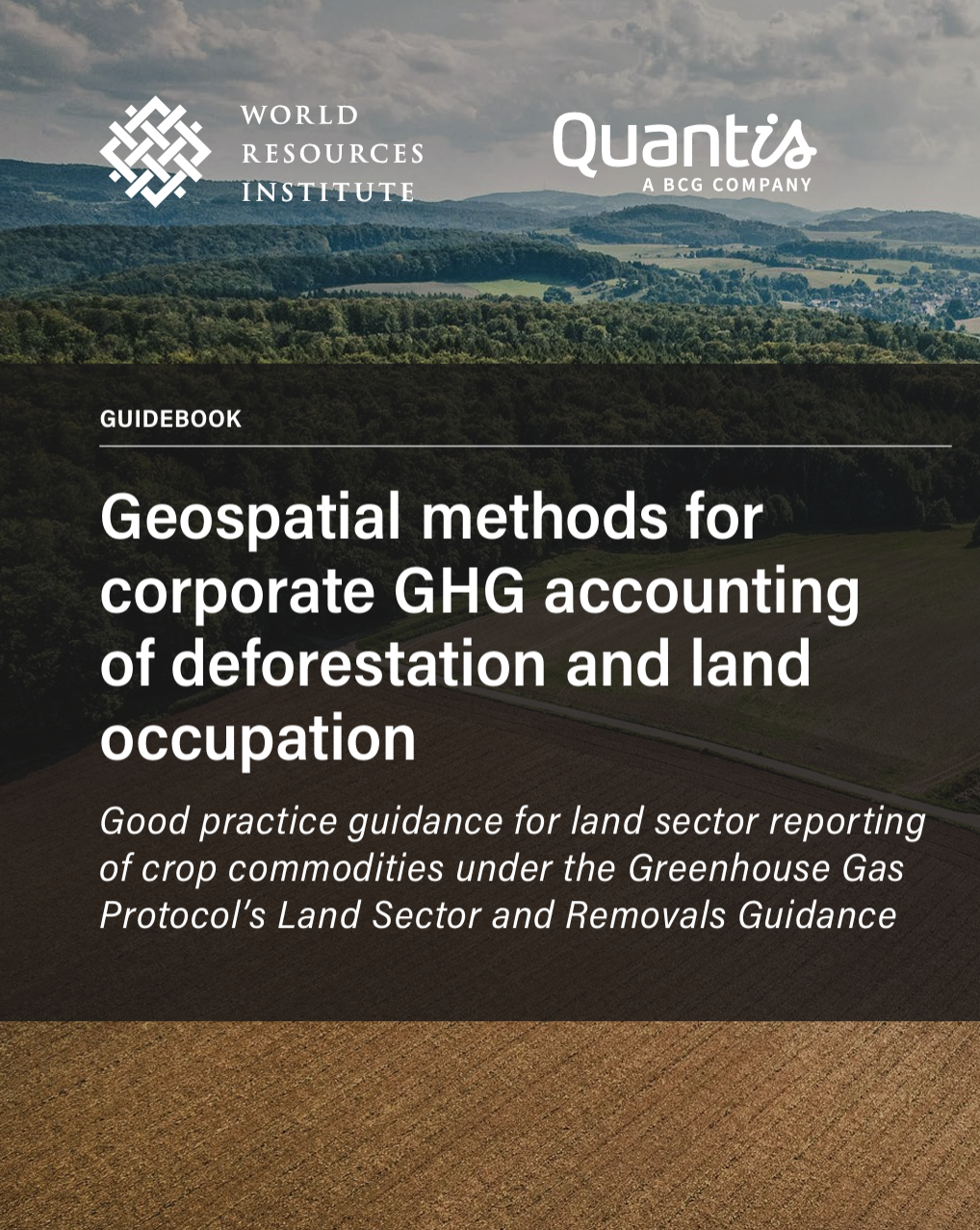
To fill this gap, World Resources Institute (WRI) and Quantis, with the support of Mérieux NutriSciences | Blonk and HowGood, are addressing the urgent need to improve comparability of scope 1 and scope 3 GHG inventories and provide a harmonized resource across agricultural commodities. To this effect, we have recently published both a guidebook and accompanying technical note. Together, we are operationalizing aligned, transparent, and science-based metrics that follow the LSRG to improve land use change emissions, starting with deforestation and land occupation in corporate accounting.
As a result, companies sourcing the same commodities from the same supply chains may report very different GHG emissions and land occupation metrics and consequently arrive at different conclusions when tracking progress toward reducing emissions or when prioritizing supply chain interventions and related investments to mitigate GHG emissions from land use change.
To fill this gap, World Resources Institute (WRI) and Quantis, with the support of Mérieux NutriSciences | Blonk and HowGood, are addressing the urgent need to improve comparability of scope 1 and scope 3 GHG inventories and provide a harmonized resource across agricultural commodities. To this effect, we have recently published both a guidebook and accompanying technical note. Together, we are operationalizing aligned, transparent, and science-based metrics that follow the LSRG to improve land use change emissions, starting with deforestation and land occupation in corporate accounting.



REPORT
Geospatial Methods for Corporate GHG Accounting of Deforestation and Land Occupation
Access the WRI Report