Products that receive the Climate Friendly attribute have GHGs emissions that are lower than 70% of all products assessed.
HowGood is an independent research company with the world’s largest database on product sustainability. With data and analysis for more than 33,000 ingredients, chemicals, and materials, HowGood helps leading brands, retailers and investors improve their environmental and social impact. Through in-depth, ingredient-level insights on factors ranging from greenhouse gas emissions to animal welfare to labor risk, HowGood data powers strategic decision-making for the sourcing, manufacturing, merchandising, and marketing of sustainable products. Brands identify opportunities to improve and invest in sustainability, drive greater transparency, and empower shoppers to make higher impact purchases.
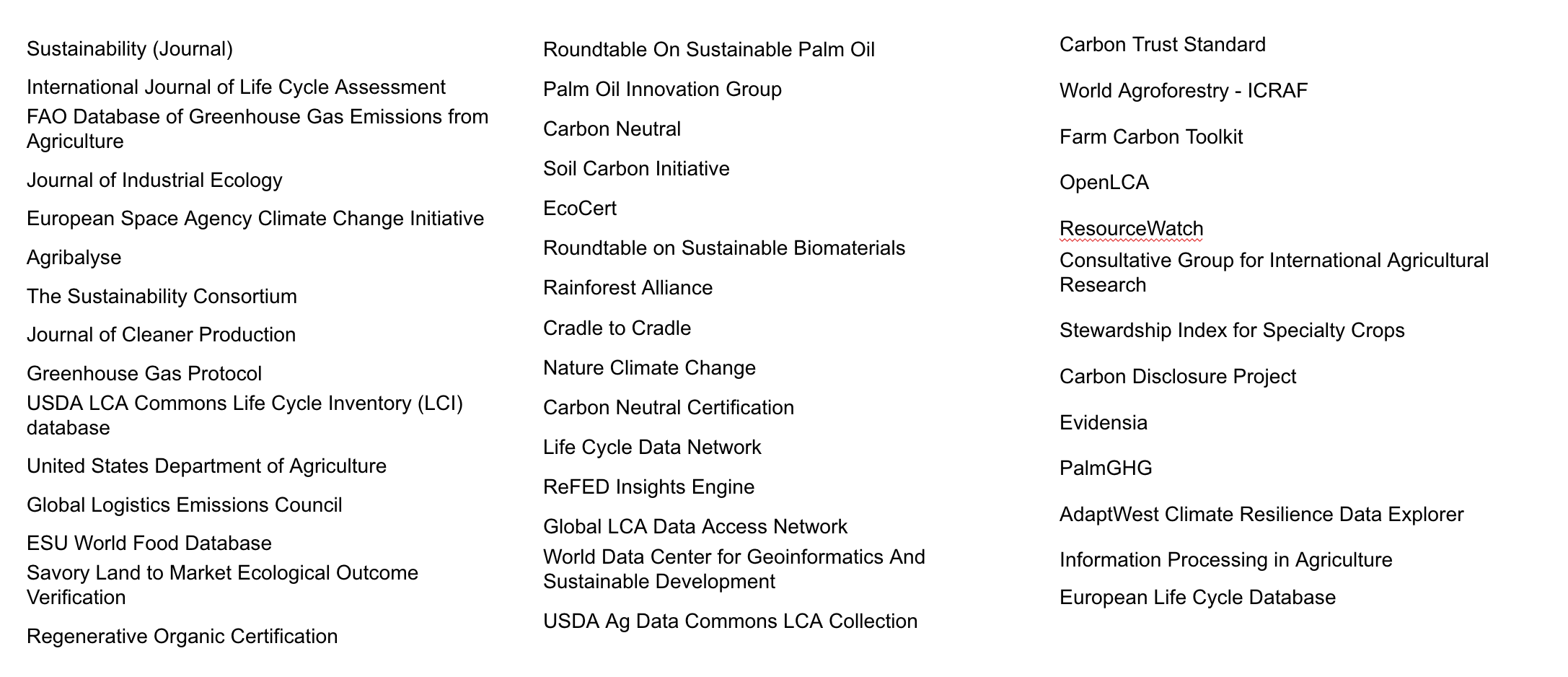
HowGood has more than 18 years of research on global food supply chains. The team consolidates and analyzes findings from over 600 accredited data sources and certifications. These include a range of resources such as peer reviewed Life-Cycle-Assessment studies, journal articles, academic conference proceedings and texts, aggregated commercial databases, targeted industry studies, NGO research, and government publications. HowGood is dedicated to not only employing the most industry-recognized methodologies but also ensuring that the latest scientific research is incorporated. Metrics and impact assessments are updated on an ongoing, iterative basis, making HowGood’s platform the leading-edge tool for product sustainability. In turn, HowGood is able to provide impact assessments that are always accurate, comprehensive, and the most up-to-date. Through HowGood’s sustainability intelligence platform, we are able to scale this approach across products, brands, and the entire food industry.
HowGood’s Climate Friendly attribute recognizes food products with low greenhouse gas emissions. HowGood assesses carbon footprint for products across the food system. Products that receive the Climate Friendly attribute have GHGs emissions that are lower than 70% of all products assessed. The assessment for the Climate Friendly attribute takes into account GHG emissions at the agricultural production and ingredient processing stages of the carbon life cycle. Agricultural production (ie. cradle-to-farm gate) includes all inputs required to produce and/or harvest crops, meat, and seafood.
Products that qualify for Climate Friendly receive access to the attribute for public-facing communications for one year. At the end of the annual contract, products must be reassessed based on the current industry benchmark to re-qualify.
The Climate Friendly attribute provides consumers with a clear indicator of how sustainable a product is with respect to carbon emissions. It’s easy-to-digest and guides consumers toward more sustainable purchases. The Climate Friendly attribute empowers shoppers to make decisions that are in line with their values and preferences. By purchasing Climate Friendly products, consumers can take a step toward reducing their carbon footprint.
HowGood’s methodology for calculating GHG emissions is developed in accordance with the GHG Protocol.
Based on the ingredient mapping process, HowGood assigns a default location and corresponding industry-average profile for every ingredient in a product. If deeper levels of data granularity are available (from a specific supplier, industry partner, or publication), these specifics are applied.
For GHG emissions, HowGood relies on the International Panel on Climate Change (IPCC) 2013 global warming potential estimates where available and crop-specific LCAs. For crops and locations where no current data exists, HowGood uses relevant LCAs from proxy locations where farming methods are deemed as similar (ie. places that have the same fertilizer requirements, same size farm, etc).