Products that achieve the Minimally Processed attribute are made with lower-energy processing, which reduces environmental impact

HowGood is an independent research company and SaaS sustainability intelligence platform with the world’s largest database on food product sustainability. For 18 years, HowGood has focused exclusively on agricultural production research and mapping global food systems. With over 90,000 agricultural emissions factors, HowGood’s database enables the food industry to accurately measure, reduce, and communicate the impact of their products. HowGood’s SaaS platform delivers automated and auditable sustainability data to some of the world’s largest food companies to power their product carbon footprinting, corporate carbon accounting, impact reduction initiatives, and strategic sourcing decisions. Visit howgood.com for more information.
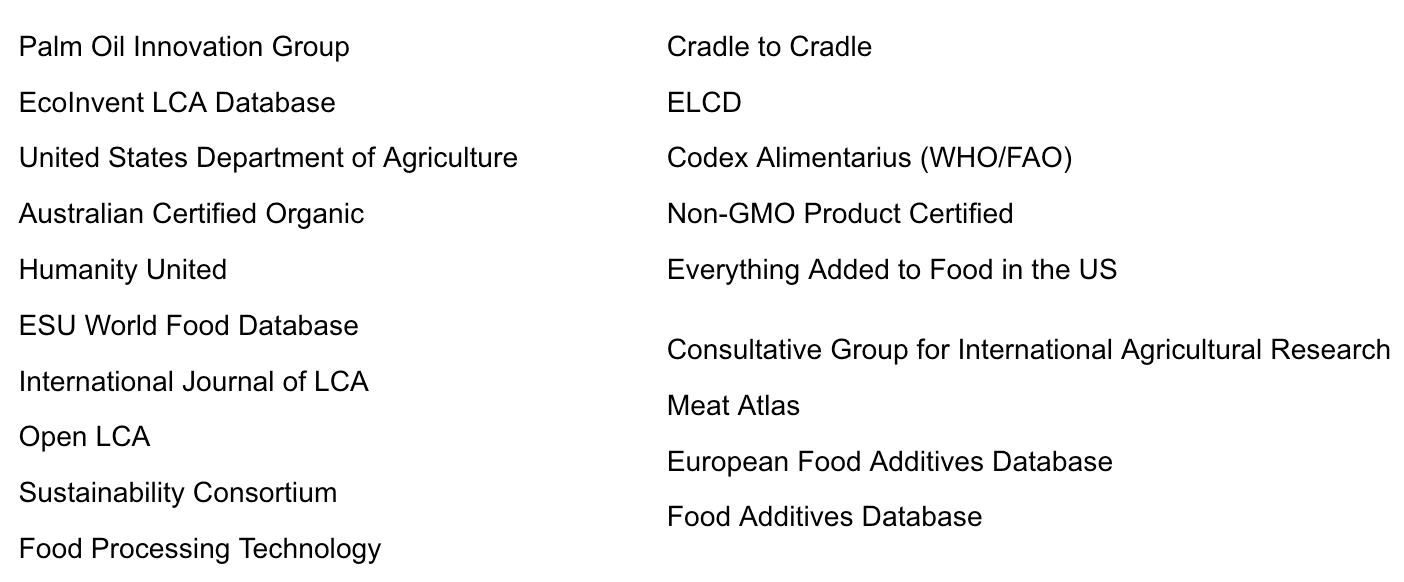
HowGood has more than 18 years of research on global food supply chains. The team consolidates and analyzes findings from over 600 accredited data sources and certifications. These include a range of resources such as international frameworks, NGO guidance and standards reports, peer reviewed life cycle assessment studies, journal articles, academic conference proceedings and texts, aggregated commercial databases, targeted industry studies, NGO research, government publications, and news reports from reputable outlets. HowGood employs the most industry-recognized methodologies and incorporates the latest scientific research. Metrics and impact assessments are updated on an ongoing, iterative basis, making HowGood’s platform the leading-edge tool for product sustainability. In turn, HowGood is able to provide impact assessments that are accurate, comprehensive, and the most up-to-date. Through HowGood’s sustainability intelligence platform, Latis, we are able to scale this approach across products, brands, and the entire food industry.
HowGood’s Minimally Processed attribute recognizes food products that are made with lower-energy processing, which reduces environmental impact. Less ingredient processing required in production also tends to yield products with better ingredient quality.
Products that receive the Minimally Processed attribute have ingredients that do not require high intensity industrial processing, and could be produced prior to the advent of food science. Low-intensity processes such as minor heat or fermentation, mechanical processing, and physical extraction are a few examples of ingredient processes that would qualify. On the contrary, ingredients that can only be produced via chemical processing, industrial fermentation, and use of solvents are examples of high intensity processes.
Note: This attribute looks at the method used to process an ingredient and does not take into account the actual energy required to do so. It also does not reward a product for its level of healthiness or nutrition, or how “natural” the product is.
Products that qualify for Minimally Processed receive access to the attribute for public-facing communications for one year. At the end of the annual contract, products must be reassessed based on the current industry benchmark to re-qualify.
The Minimally Processed attribute provides consumers with an indicator of the intensity of an ingredient’s transformation, as indicated by the degree of processing involved in producing its ingredients. It’s easy-to-digest and guides consumers toward decisions that are in line with their health goals and dietary preferences. By purchasing Minimally Processed products, consumers can take a step toward making more informed choices on what they choose to purchase.
The Minimally Processed product attribute rewards low-intensity ingredient processing. To receive the Minimally Processed attribute, products must only contain ingredients that are not dependent on commercial/industrial processing to exist. Minor heat or fermentation, mechanical processing (e.g., milling of grain), and physical extraction (e.g., expeller pressing of olives) are examples of low-intensity ingredient processes accepted for this attribute. The ingredient may be augmented by the food system but not created by it. Some ingredients ubiquitous in the food system used as supplements added in small quantities to enrich foods are included as minimally processed despite being dependent on commercial/industrial processing, and constitute the notable exception to this rule.
HowGood’s methodology for calculating processing impact involves:
Based on the ingredient mapping process, HowGood assigns a default processing type and corresponding industry-average profile for every ingredient in a product. If deeper levels of data granularity are available (from a specific supplier, industry partner, or publication), these specifics are applied.
Data Sources: