Products that receive the Water Smart attribute are less of a stress on the water supply in the regions where their ingredients are produced.
HowGood is an independent research company and SaaS sustainability intelligence platform with the world’s largest database on food product sustainability. For 18 years, HowGood has focused exclusively on agricultural production research and mapping global food systems. With over 90,000 agricultural emissions factors, HowGood’s database enables the food industry to accurately measure, reduce, and communicate the impact of their products. HowGood’s SaaS platform delivers automated and auditable sustainability data to some of the world’s largest food companies to power their product carbon footprinting, corporate carbon accounting, impact reduction initiatives, and strategic sourcing decisions. Visit howgood.com for more information.
HowGood has more than 18 years of research on global food supply chains. The team consolidates and analyzes findings from over 600 accredited data sources and certifications. These include a range of resources such as international frameworks, NGO guidance and standards reports, peer reviewed life cycle assessment studies, journal articles, academic conference proceedings and texts, aggregated commercial databases, targeted industry studies, NGO research, government publications, and news reports from reputable outlets. HowGood employs the most industry-recognized methodologies and incorporates the latest scientific research. Metrics and impact assessments are updated on an ongoing, iterative basis, making HowGood’s platform the leading-edge tool for product sustainability. In turn, HowGood is able to provide impact assessments that are accurate, comprehensive, and the most up-to-date. Through HowGood’s sustainability intelligence platform, Latis, we are able to scale this approach across products, brands, and the entire food industry.
HowGood’s Water Smart attribute recognizes food products that are less of a stress on the water supply in the regions where their ingredients are produced. It is based on the Blue Water Usage metric which takes into account both the blue water used in growing the ingredients of a product and the blue water scarcity in those respective regions. In order for a product to receive the Water Smart attribute, its total blue water impact must be better than 80% of all products assessed by HowGood.
Products that qualify for Water Smart receive access to the attribute for public-facing communications for one year. At the end of the annual contract, products must be reassessed based on the current industry benchmark to re-qualify.
The Water Smart attribute provides consumers with a clear indicator of a product’s impact on freshwater resources. It’s easy-to-digest and guides consumers toward more sustainable purchases. The Water Smart attribute empowers shoppers to make decisions that are in line with their values and preferences. By purchasing Water Smart products, consumers can take a step toward reducing their water footprint.
Blue Water Usage is a measure of the amount of blue water appropriation, adjusted for the degree of blue water scarcity in the location where the ingredient is grown. Blue water appropriation refers to the withdrawal and use of water from freshwater lakes, rivers and aquifers for human activities.
The Blue Water Usage metric has two components:
For a crop, the Blue Water Footprint (WFblue) is calculated as follows (Hoekstra et al. 2011, p. 41):


Where:
CWUblue = crop blue water use (m3/ha)
Y = yield (tonne/ha)
ETblue = evapotranspiration (mm/day)
lgp = length of growing period
The Blue Water Scarcity (WSblue) is usually calculated at catchment level and provides an estimate of how much of the available blue water has been already appropriated by human activities within a certain geographical area. It is calculated as follows (Hoekstra et al. 2011, p. 82-85):
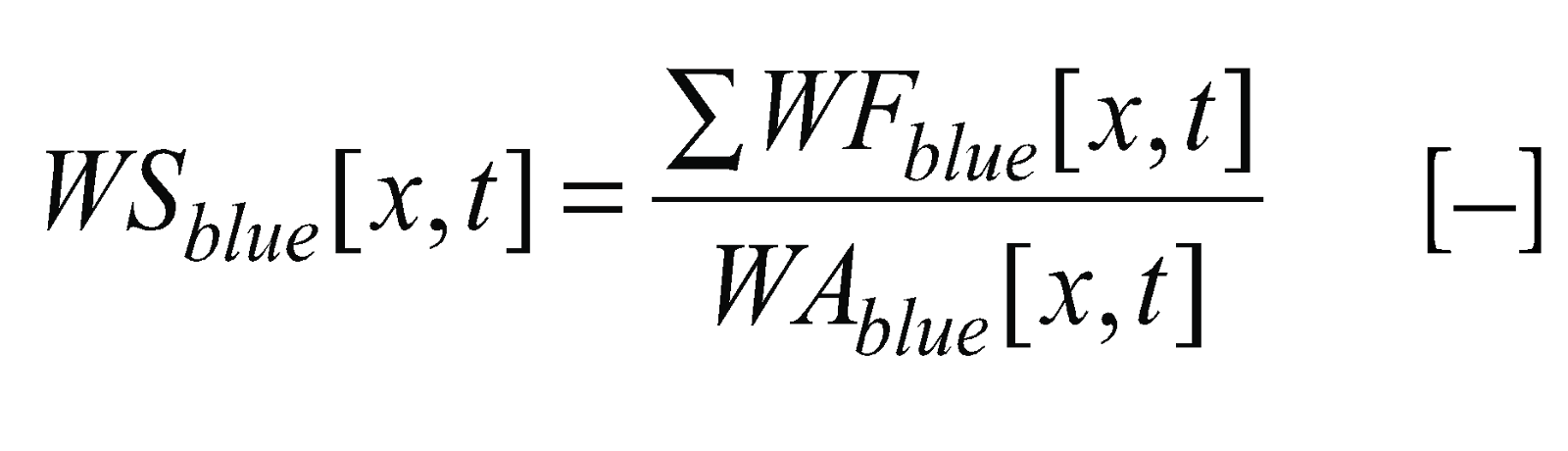

Where:
WAblue = Blue water availability
Rnat = natural run-off in the catchment
EFR = environmental flow requirement (to sustain ecosystems and human livelihoods)
If:
WSblue < 100% → Available blue water for human appropriation has not been fully consumed (sustainable blue water consumption level)
WSblue = 100% → Available blue water for human appropriation has been fully consumed
WSblue > 100% → Unsustainable blue water appropriation value
Finally, the Blue Water Usage metric is calculated as follows:
Blue Water Usage = Blue water footprint * Blue water scarcity [L/kg]
The Blue Water Usage impact spectrum divides the blue water impact values of the ingredients in HowGood’s database into deciles. If an ingredient has an impact lower than 90% of all ingredients in our database, it will score a 10. If it has an impact lower than only 10% of all ingredients in our database, it will score a 1.
HowGood draws on the values for blue water usage in the dataset provided by Mekonnen & Hoekstra (2011, 2012), while the blue water scarcity values are extrapolated from the geographical database provided by Mekonnen & Hoekstra (2016). For crops and locations where no current data exists, HowGood uses supplementary studies and relevant LCAs from proxy locations where environmental conditions and farming methods are deemed as similar.
Data Sources:
Mekonnen, M.M. & Hoekstra, A.Y. (2011) The green, blue and grey water footprint of crops and derived crop products, Hydrology and Earth System Sciences, 15(5): 1577-1600. https://waterfootprint.org/en/resources/waterstat/product-water-footprint-statistics/
Hoekstra, A.Y., Chapagain, A.K., Aldaya, M.M. and Mekonnen, M.M. (2009). The water footprint assessment manual. Earthscan, London: Water footprint network. https://waterfootprint.org/en/resources/publications/water-footprint-assessment-manual/
Mekonnen, M.M. & Hoekstra, A.Y. (2012) A global assessment of the water footprint of farm animal products, Ecosystems, 15(3): 401–415. https://waterfootprint.org/en/resources/waterstat/product-water-footprint-statistics/
Mekonnen, M.M. & Hoekstra, A.Y. (2016) Four billion people facing severe water scarcity, Science Advances, 2(2): e1500323. https://waterfootprint.org/en/resources/waterstat/water-scarcity-statistics/
Additional sources used for the scientific assessment of the metric methodology, data quality assessment and proxy identification include:
The Food and Agriculture Organization of the United Nations
UNESCO Institute for Water Education
The International Journal of Life Cycle Assessment
Water Resources Management
Environmental Science & Technology
Water (Journal)
Nature
Resources (Journal)
Water Resources and Industry
Agriculture (Journal)
Sustainability (Journal)
Advances in Water Resource
Hydrology and Earth System Sciences
Ecosystems (Journal)
Science Advances (Journal)
University of Twente
University of Regina
